
Is Alberta’s Separation Question Still in Play?
The Courts Blocked the Petition. Not the Referendum.

Yes it is — and the mechanism to keep it in play is within Danielle Smith’s control.
Two courts blocked the citizen petition route separatists were relying on. Neither ruling affected cabinet’s authority under section 1 of the Referendum Act to add a constitutional question to the October referendum through Order in Council — no petition is required.
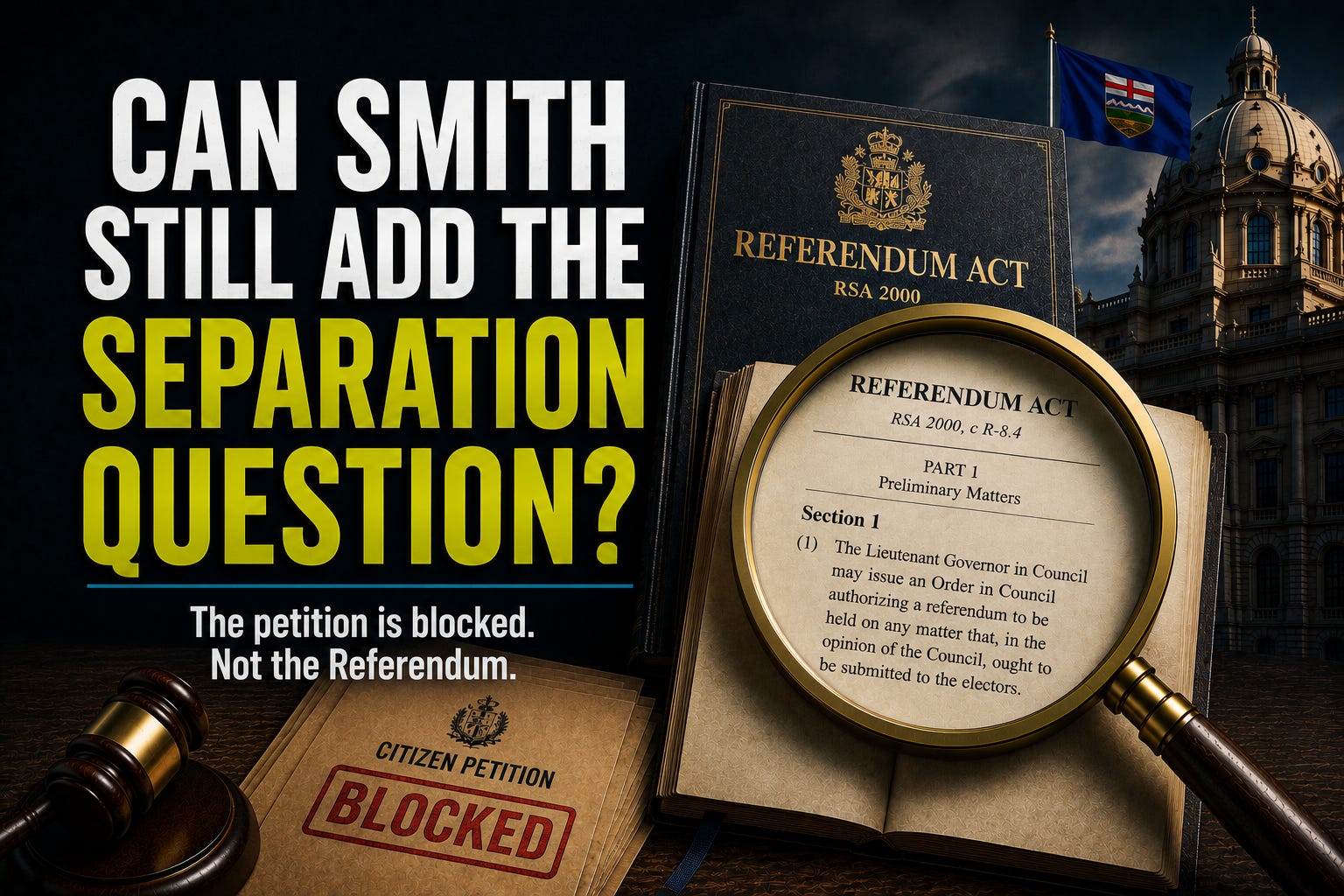
Smith leads a majority government, meaning the steps to add the question to the October referendum requires only an internal political decision.
The Citizen Initiative Route Is Blocked
Justice Colin Feasby ruled in December 2025 that the proposed citizen-initiative referendum could not proceed under the Citizen Initiative Act because it contravened Treaty and Aboriginal rights protections.
In response, the government passed Bill 14, amending the Citizen Initiative Act to remove the prohibition on unconstitutional referendum questions.
On May 13, 2026, Justice Shaina Leonard quashed the revised petition on the same constitutional basis.
Both the separatist organizers and the Alberta UCP government have announced they will appeal.
How Smith and the UCP Can Add it to the Referendum
Under section 1 of the Referendum Act, the process is straightforward:
cabinet approves a separation question,
the Lieutenant Governor in Council issues a new or amended Order in Council,
Elections Alberta publishes the revised referendum framework,
and the referendum proceeds under the Election Act and related regulations.
Prominent separatist and land-use lawyer Keith Wilson publicly called on the government to use this route following Leonard’s ruling.
Smith has not publicly committed to it, saying caucus and cabinet will discuss next steps. The process requires no approval beyond cabinet itself.
The Constitutional Obligations That Follow
Adding a separation question through cabinet authority does not bypass the constitutional obligations that blocked the petition.
Both rulings turned on the Crown’s duty to consult First Nations before advancing a process that could affect treaty rights — regardless of the mechanism used.
Athabasca Chipewyan First Nation, Blood Tribe, Piikani Nation, and Siksika Nation are already active litigants.
A government-initiated question gives them standing to legally challenge on identical grounds — before the October referendum, during it, and after it — with the government as the named party rather than the petitioners.
What Smith’s Statements Put on the Record
Smith has called Leonard’s ruling “incorrect in law and anti-democratic.” On her May 16 radio program, she stated the provincial government will intervene in cases where it feels judges may be overstepping.
Those statements come from the same government the courts found had not met its duty to consult. Both rulings identified the conduct of the Alberta government as central to their findings.
Smith’s public statements characterizing those findings as anti-democratic and are now part of the public record.
Smith’s framing of the court findings also sits in direct tension with the Canada-Alberta energy collaboration MOU, which requires billions in private capital that becomes considerably less likely if investors perceive political instability.
The Judicial Appointments Question
If Smith adds the separation question through cabinet authority, it would appear on the same October 19 ballot as a binding constitutional question asking whether provinces should control judicial appointments.
Courts may be asked to rule on the legality of the separation question while Albertans vote on whether judicial appointments should remain federal or become provincial.
A strong yes on judicial appointments gives Smith an immediate mandate claim to pressure Ottawa on the judiciary — regardless of how courts rule on the separation question.
The cost to Albertans is documented. The Canadian Bar Association warned in February 2026 that the proposal would “fundamentally compromise” the non-partisan appointment process. Alberta’s chief justices at all three court levels issued a separate rare joint statement in January 2026 defending judicial independence.
Politicizing appointments affects every Albertan who uses courts — and Smith's framing of adverse rulings as anti-democratic deepens the social division this process is already producing.
The Other Side of the Democratic Ledger
While the government considers adding a separation question, a verified democratic signal already exists — and remains unaddressed.
Elections Alberta certified the Forever Canadian petition in December 2025 — 404,293 verified signatures, the largest citizen-initiated petition in Alberta history — legally obligating the government to refer it to a legislative committee within 10 sitting days. What followed:
The government waited three months to strike the committee.
When it met in April 2026, UCP members voted down a motion to complete the review before the legislature rose in May.
The legislature does not sit again until October 27 — after the referendum.
Thomas Lukaszuk, who organized the Forever Canadian petition, said in April 2026: “It is now abundantly clear to any objective viewer that the premier is doing everything she possibly can to assist the separatists.”
What This Costs Albertans
The referendum already carries documented financial costs — and adding another question extends them:
Elections Alberta’s budget is set to double from approximately $26 million to $52 million in 2026-27, with the increase attributed to the October 19 referendum.
Taxpayers also funded government lawyers who argued in court on behalf of advancing the separatist petition process.
The cost of the government’s publicly funded referendum campaign website and promotional materials has not been disclosed — a public expenditure whose full amount Albertans cannot currently verify.
The economic cost is already measurable. A March 2026 Calgary Chamber of Commerce survey found that 51% of Calgary business respondents believe separatist discourse is affecting the provincial economy — 93% of them negatively. Among those respondents, 83% identified higher recession risk and 74% identified businesses considering relocation or expansion outside Alberta as likely impacts.
Five of the nine questions already on the October ballot are pre-declared non-binding by the government’s own Order in Council — meaning the province has no legal obligation to act on results regardless of how Albertans vote.
A separation question added through the same mechanism carries the same absence of obligation.
Factsmtr Analysis
Nearly every procedural step has advanced either Smith’s political position or the separatist movement’s objectives.
For Albertans the documented record offers costs without guaranteed returns. The broader costs are measurable economic uncertainty, documented social division, and undisclosed public expenditure.
The referendum environment itself compounds this.
A voter data breach affecting nearly three million Albertans remains under active investigation with no public inquiry called and the lead organizer refusing to comply.
CSIS director Daniel Rogers told CBC News on May 9, 2026 that Alberta’s potential vote is susceptible to foreign interference.
A May 2026 research report warned that adding a separation question to the October ballot would significantly increase that interference.
Former RCMP intelligence director Patrick Lennox put Canada’s capacity to respond plainly: “no capacity whatsoever to push back against” what follows.
A yes vote on a separation question would land in that environment — amid an unresolved data breach, documented foreign interference, and no stated capacity to protect the integrity of the result.
The question of whether Smith can add the separation question is yes. Smith can add the question.
The decision is hers and her governments to make.
The legal, political, economic, social, and constitutional consequences, no matter what she decides, are already unfolding.
If you found this analysis useful, share it with someone who should read it. If you think the documented record shows something different, the comments are open.
If this post raised questions about how to verify claims, contact decision-makers, or take civic action on issues like this one, check out the Factsmtr Civic Learning Series. New courses added each month. Available to paid subscribers.
Dani must prefer hanging out with the separatists rather than building an interprovincial pipeline to ship her province's resources to asia, with federal cooperation and probably funding assistance. How can she have both separatist bffs and a big new pipeline?
It is probably incorrect, from a practical perspective, to refer to any of the 9(10) referendum questions as "binding". In truth this is just an expensive public opinion survey because acting upon any off them in a concrete manner does not involve a unilateral action by Alberta. At best they require engagement with the federal and other provincial governments, and First Nations in some instances, to negotiate modifications to the way the. Canadian Federation functions.